Old-world methods are traditional, time-intensive production practices—such as natural fermentation, extended aging, hand-working, and slow drying—that allow materials and organisms to change gradually. Their distinctive textures are not simply signs of age: they emerge from interactions among ingredients, microbes, temperature, moisture, time, and human judgment. In bread, cheese, wine, and textiles, those interactions can create structures that rapid, standardized processes may not reproduce in the same way. The evidence is strongest when specific mechanisms are considered: fermentation alters dough and flavor, cheese aging changes moisture and protein structure, and slow textile processes affect fiber and surface. Yet “slow” alone does not guarantee quality; craft, conditions, and intended use matter too.
How Old-World Method Mastery Creates Irreplaceable Textures
The phrase “old-world method” is a broad description rather than a single technical category. It usually refers to inherited or historically rooted techniques that rely on extended time, controlled natural change, manual skill, or traditional tools. “Irreplaceable texture” should also be understood carefully: it does not mean modern production cannot make excellent products. It means that a particular combination of structure, variability, and sensory character may be difficult to duplicate when a process is shortened or redesigned.
The topic is relevant both culturally and economically. UNESCO’s 2010 inscription of the “Gastronomic meal of the French” recognizes food practices as part of cultural heritage, while UNESCO’s 2021 inscription of traditional knowledge and skills in French baguette bread culture documents the craft behind a familiar food. At the same time, food science shows why process details matter: the Food and Agriculture Organization of the United Nations (FAO) describes fermentation as a means of transforming food through the action of microorganisms and enzymes. The sections below connect that principle to bread, cheese, wine, and textiles, then consider how makers can preserve traditional character while maintaining safety and consistency.
Old-World Method Mastery Depends on Time, Transformation, and Skilled Control
Old-world method mastery can be defined as the practiced ability to manage a traditional process so that its materials develop toward a desired structure and character. It is not merely following an old recipe. It involves knowing how a dough feels as it ferments, how a cheese rind is progressing, when a wine is ready for the next stage, or how a fiber responds to washing and drying. Food historian Rachel Laudan and culinary institutions often distinguish food traditions by their techniques and social histories; in practical production, the observable process and its outcomes provide the clearest definition.
The main characteristics are extended or staged processing, close attention to environmental conditions, and decisions made in response to the material rather than to a fixed clock alone. Related methods, or hyponyms, include sourdough and long-fermented breads; raw-milk or traditionally ripened cheeses; spontaneous or mixed-culture wine fermentations; and hand-spun, naturally dyed, or hand-finished textiles. These methods differ, but each depends on a sequence in which small changes accumulate.
Slow processing gives materials time to change
Slow processing means allowing a material to undergo gradual physical, chemical, or biological change. In fermentation, microorganisms consume available sugars and produce compounds that affect acidity, aroma, and structure. In aging, moisture migrates and enzymes continue to act. In textile finishing, washing, fulling, drying, or repeated handling can alter how fibers lie together and how a cloth feels. The texture is therefore an outcome of the process, not an added decoration.
The FAO’s guidance on traditional fermented foods emphasizes that fermentation depends on microorganisms and enzymes, while the U.S. Food and Drug Administration (FDA) stresses that food safety depends on controlling relevant hazards. These points belong together: time can build desired qualities, but it must be managed alongside temperature, acidity, hygiene, and other process controls. A longer process is not automatically safer or better.
Craft knowledge turns variation into control
Craft knowledge is the practical skill used to interpret changing materials. A baker may adjust fermentation based on dough temperature and strength; a cheesemaker may assess rind development and humidity; a dyer may judge color depth by repeated samples. This sensory knowledge complements measurement rather than replacing it. Modern instruments can record temperature, acidity, and moisture, while an experienced maker notices changes that a single measurement may not capture.
UNESCO’s account of baguette culture illustrates this combination of technique and community knowledge: the heritage is not just a finished loaf, but the practices and skills involved in making it. That distinction provides a bridge to the individual product categories. The texture in each case depends on what the material is, what changes during processing, and how the maker responds.
Traditional Fermentation Builds Bread and Cheese Texture
Fermentation is a biological process in which microorganisms transform substrates, producing compounds that can alter flavor, acidity, gas formation, and texture. Its effects differ by product: bread relies on gas retention in dough, while cheese relies on coagulated milk proteins, moisture management, and ripening. These are related examples of slow transformation, but they are not interchangeable processes.
Long-fermented bread develops an open, resilient crumb
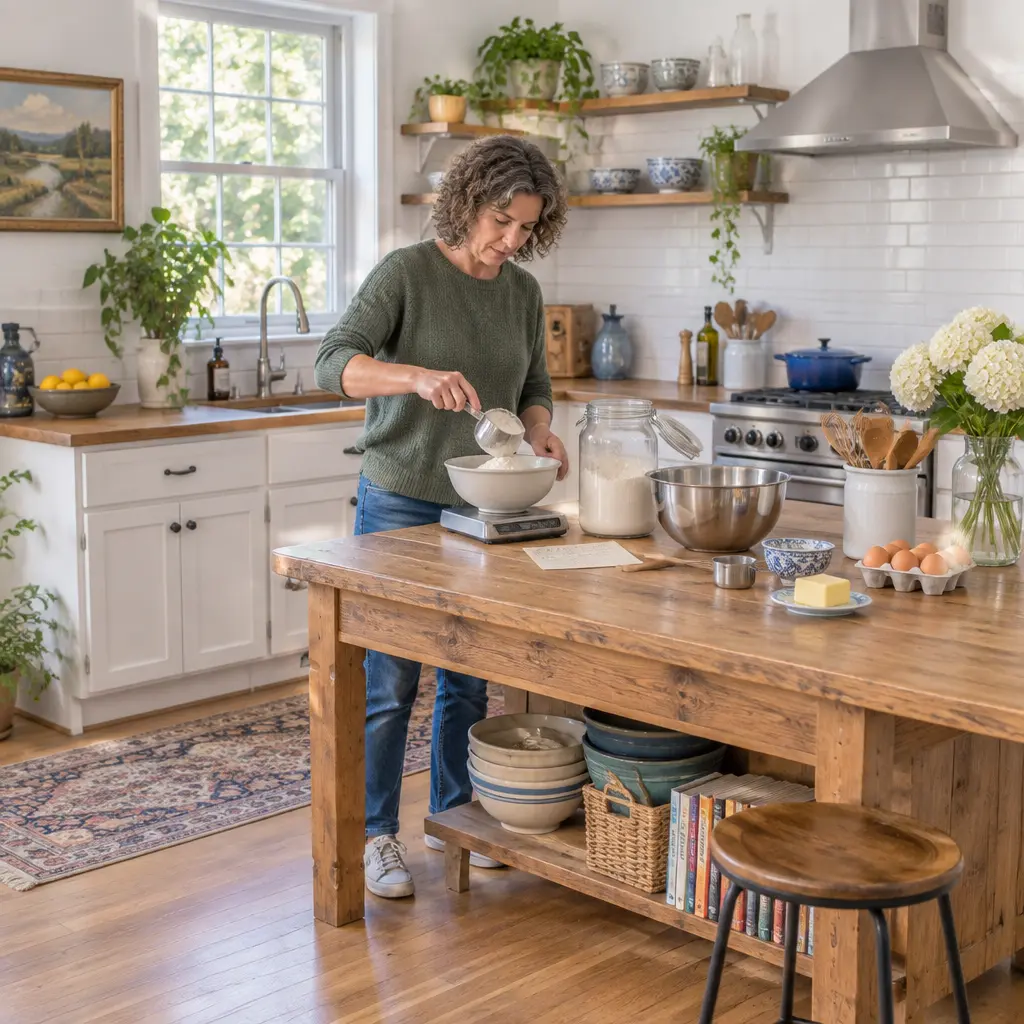
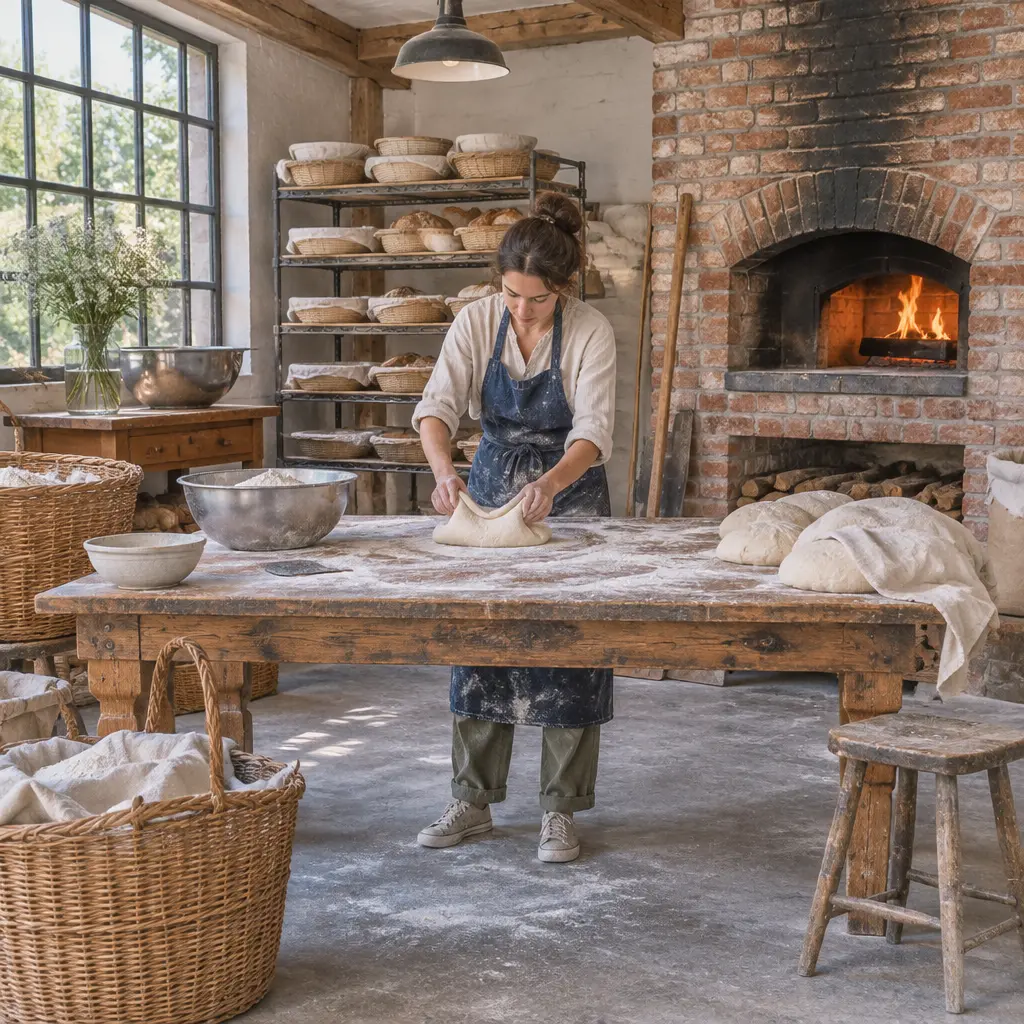
In breadmaking, fermentation produces carbon dioxide and other compounds. The dough’s gluten network traps gas, expanding into a crumb whose structure depends on flour, hydration, mixing, fermentation, shaping, and baking. Sourdough uses a community of yeasts and lactic-acid bacteria; a baker manages that culture through feeding, temperature, and timing. A longer fermentation can influence acidity and aroma and can change dough strength, but the result depends on the formula and conditions.
The American Society for Microbiology describes sourdough as a fermentation system involving yeasts and lactic-acid bacteria. This helps explain why a mature starter can contribute more than leavening: microbial activity produces acids and volatile compounds that shape the bread’s sensory character. UNESCO’s baguette heritage record likewise centers traditional skill and practice, rather than claiming that one fermentation schedule guarantees a particular crumb. A slow dough can be dense or weak if hydration, flour, or handling is poorly matched to it.
Cheese ripening changes moisture, proteins, and rind
Cheese ripening is the controlled maturation of a cheese after it has formed. During ripening, enzymes and microorganisms break down proteins and fats, while moisture and salt distribution continue to shape the body. Surface-ripened cheeses develop changes from the rind inward; other styles mature more uniformly or develop openings and distinct elastic or crumbly structures.
The University of Guelph’s cheese science resources explain that ripening involves complex biochemical changes, including proteolysis—the breakdown of proteins into smaller compounds. This process contributes to both flavor and texture: a firm young cheese may soften as its protein network changes, while moisture loss can make another cheese denser. Raw-milk and traditional-rind methods can introduce additional microbial complexity, but production must still comply with applicable food-safety requirements. The FDA’s guidance on dairy safety underscores why traditional character cannot substitute for validated controls.
Extended Aging and Hand-Finishing Shape Wine and Textiles
Where bread and cheese show biological transformation, wine and textiles demonstrate how time also works through maturation, material handling, and finishing. In both fields, the maker manages a sequence of changes rather than applying a single technique. The result can be a complex sensory profile in wine or a distinctive surface and drape in cloth.
Wine maturation develops structure gradually
Wine aging is the period during which wine changes after fermentation, in a tank, bottle, or barrel. Oxygen exposure, temperature, vessel material, and the wine’s composition influence how it evolves. Barrel aging may add compounds from the wood and allow limited oxygen interaction; bottle aging proceeds under different conditions. These changes can affect aroma, astringency, and perceived structure, but age alone does not make every wine better.
The International Organisation of Vine and Wine (OIV) publishes technical standards and terminology for wine production, while the University of California, Davis Department of Viticulture and Enology explains the chemistry and microbiology behind wine processes. Together, these sources support a key distinction: traditional vessel choices and extended aging can contribute to a particular style, but the outcome depends on grape variety, fermentation, storage, and the wine’s suitability for maturation. A chart comparing tank, barrel, and bottle aging could illustrate the different exposure conditions, but it should not imply that one vessel is universally superior.
Hand-spinning and finishing preserve textile character
Traditional textile production can involve hand-spinning, hand-weaving, natural dyeing, fulling, or other finishing operations. Each can influence fiber alignment, yarn irregularity, surface, weight, and drape. For example, hand-spun yarn may vary slightly in diameter, creating a texture unlike a highly uniform industrial yarn. Fulling—agitating wool fabric with moisture and heat—can cause fibers to interlock and the cloth to become denser. Natural dyes can also vary with plant material, water chemistry, mordant, and dyeing conditions.
The Smithsonian Center for Folklife and Cultural Heritage documents textile traditions as living systems of knowledge, materials, and making. The International Wool Textile Organisation describes wool’s capacity to felt and its response to moisture and agitation, helping explain why finishing changes the cloth’s hand and structure. These examples show why “texture” extends beyond food: it can mean the tactile surface, flexibility, density, or movement of a material. A simple process diagram could show fiber preparation, spinning, weaving, and finishing as stages where texture is shaped.
Traditional Texture Is Valuable but Not Automatically Superior
Traditional methods can preserve place-based identity, specialist knowledge, and sensory differences. They may also require more labor, space, storage, and monitoring than highly standardized production. The European Commission’s protected designations for agricultural products provide one example of how regional names and production specifications can be formally recognized. Such protection does not prove that a protected product is objectively better; it links a product’s identity to defined origin and practice.
Slow processes also face practical constraints. Fermentation and aging can vary with seasonal temperatures and raw-material differences. Longer storage ties up equipment and inventory, and a natural process can produce defects if conditions drift. Conversely, industrial control can deliver consistency, affordability, and safety at scale. The useful comparison is not “traditional versus modern” as a contest, but whether the process is suited to the desired product and whether its risks and trade-offs are managed.
Process control protects quality and safety
Process control means monitoring the variables that affect both product quality and safety. Depending on the product, these can include time, temperature, acidity, humidity, sanitation, salt concentration, and storage conditions. Makers can preserve traditional techniques while recording critical measurements and using validated procedures. This approach protects the distinctive process without treating tradition as a substitute for evidence.
For food businesses, the FDA’s preventive-controls framework and relevant national regulations provide practical context for managing hazards. For consumers, reliable texture is not a safety test: appearance, aroma, or a firm surface cannot establish that a product is safe. For textiles, quality checks may instead focus on fiber identity, colorfastness, shrinkage, and durability. The appropriate controls therefore depend on the material and intended use.
Conclusion: Mastery Makes Slow Methods Meaningful
Old-world method mastery creates distinctive textures through time, transformation, and informed human control. Long fermentation can shape bread’s crumb and flavor; cheese ripening alters moisture and protein structure; wine maturation develops gradually under specific conditions; and hand-spinning or finishing can give textiles characteristic surfaces and drape. Across these examples, the defining feature is not slowness by itself, but the skilled management of a process that allows materials to change.
These methods matter because they preserve craft knowledge and sensory diversity while connecting products to communities and histories. They are not automatically better, safer, or more sustainable than modern alternatives, and the available evidence does not support a single numerical measure of “irreplaceable texture.” Readers can explore local bakeries, cheesemakers, wineries, and textile studios, ask how their processes are controlled, and consult food-science or heritage resources to understand what makes each product distinctive.
Sources: UNESCO, “Gastronomic meal of the French,” https://ich.unesco.org/en/RL/gastronomic-meal-of-the-french-00437/; UNESCO, “Artisanal know-how and culture of baguette bread,” https://ich.unesco.org/en/RL/artisanal-know-how-and-culture-of-baguette-bread-01883/; Food and Agriculture Organization of the United Nations, “Fermented Fruits and Vegetables: A Global Perspective,” https://www.fao.org/4/x0560e/x0560e00.htm; U.S. Food and Drug Administration, “Hazard Analysis and Risk-Based Preventive Controls for Human Food,” https://www.fda.gov/food/food-safety-modernization-act-fsma/fsma-final-rule-preventive-controls-human-food; American Society for Microbiology, “Sourdough: A Traditional Fermented Food,” https://asm.org/articles/2020/may/sourdough-a-traditional-fermented-food; University of Guelph, “Cheese Science Toolkit,” https://www.uoguelph.ca/foodscience/book-page/cheese-science-toolkit; International Organisation of Vine and Wine, “OIV Standards and Publications,” https://www.oiv.int/standards; University of California, Davis, Department of Viticulture and Enology, “Enology,” https://wineserver.ucdavis.edu/industry-info/enology; Smithsonian Center for Folklife and Cultural Heritage, “Craft and Traditional Arts,” https://folklife.si.edu/; International Wool Textile Organisation, “Wool Processing,” https://iwto.org/wool-supply-chain/wool-processing/; European Commission, “Geographical Indications and Quality Schemes,” https://agriculture.ec.europa.eu/farming/geographical-indications-and-quality-schemes_en.