
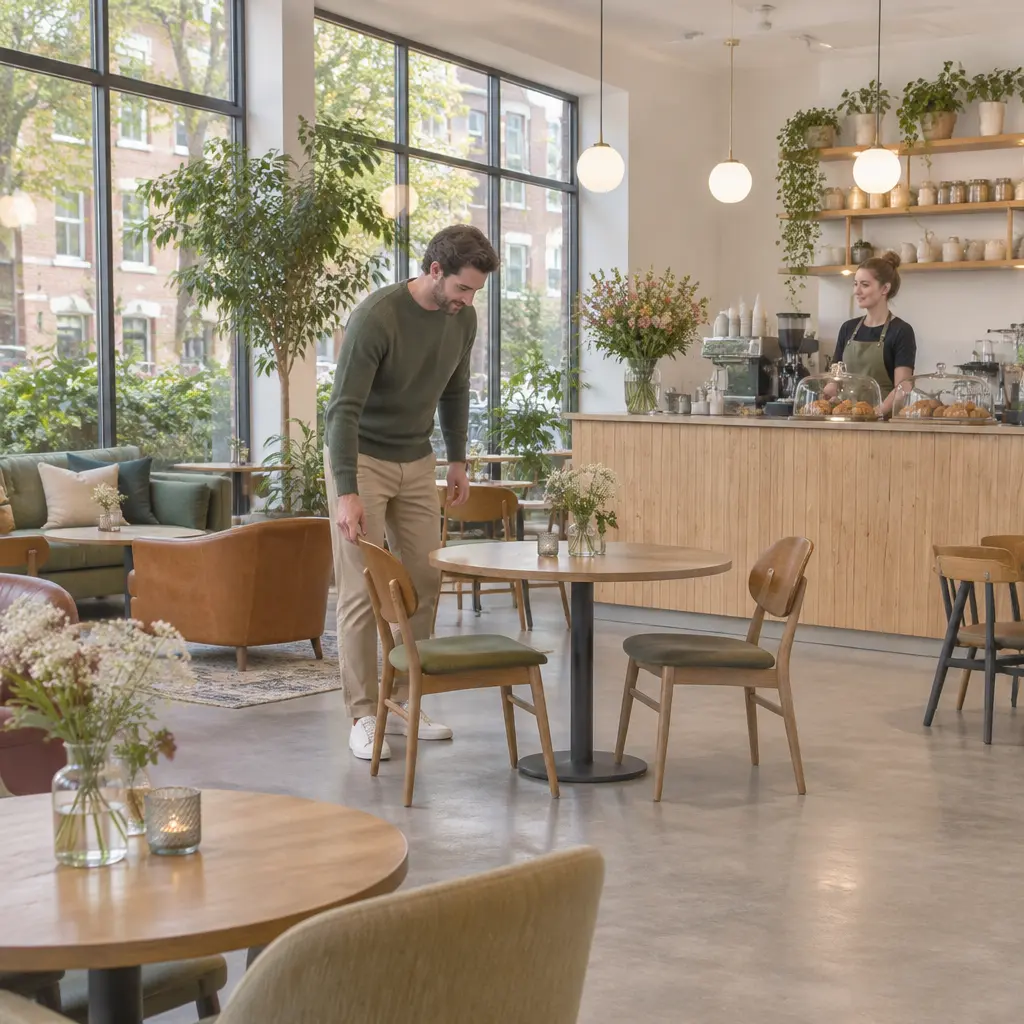
A welcoming café atmosphere is the deliberate arrangement of space, sensory conditions, and social cues that helps different people feel comfortable sharing a place without implying that they are friends or owe one another interaction. Good design can cultivate belonging through choice, accessibility, legibility, and respectful service—not staged “community” rituals. This matters in a sector where the National Restaurant Association reported that U.S. restaurant and foodservice sales were projected to reach $1.1 trillion in 2024. Drawing on environmental psychology, hospitality research, accessibility guidance, and real-world café practices, this article explains the design principles, practical features, trade-offs, and evaluation methods that can make a café feel inclusive without manufacturing artificial intimacy.
Designing café atmosphere to cultivate belonging without manufacturing artificial intimacy
Defines belonging-centered café atmosphere
A belonging-centered café atmosphere is the set of physical, sensory, operational, and interpersonal conditions that lets customers feel they are welcome and entitled to use the space, whether they arrive alone or with others. It does not require customers to socialize, disclose personal information, participate in activities, or perform enthusiasm. Environmental psychologist David Canter’s work on places emphasizes that settings are understood through the relationship between physical form, people, and their activities; a café’s meaning therefore comes not only from décor but also from how people can use it and how staff treat them.
The distinction is important: belonging is a sense of legitimate presence, while intimacy implies a degree of personal closeness. A café can support the first without demanding the second. Research by Ray Oldenburg popularized the “third place”—a setting beyond home and work where people can spend time and encounter others. But that idea is most useful when treated as an invitation, not a requirement. A regular may enjoy familiar faces; a first-time visitor should still be able to order, sit, and leave without being pressed into conversation.
The scale of the industry makes these choices consequential. The National Restaurant Association’s 2024 outlook projected $1.1 trillion in U.S. restaurant and foodservice sales and a workforce of 15.7 million. Those figures describe the broad sector, not cafés alone, but they illustrate how many everyday public-facing encounters depend on hospitality environments. Café atmosphere can influence comfort, dwell time, repeat visits, staff workload, and whether people with different needs can use a venue at all.
Explains how spatial choice and sensory comfort create belonging
Spatial choice is the provision of meaningful options in seating, movement, and degrees of visibility. It is a practical foundation for belonging because customers differ: one person may want a window seat and gentle activity, another a quiet corner, and another a table suitable for a group or mobility device. A single “ideal” seating arrangement cannot serve everyone.
Seating choice and territorial comfort
Territorial comfort means being able to occupy a seat without feeling exposed, trapped, or forced to defend it. A mix of two-person tables, communal seating, counter places, and a few more sheltered seats lets visitors choose their preferred level of contact. Keep routes to the entrance, counter, restrooms, and exits clear; avoid placing every solo customer at a communal table or making the only quiet seats feel like reserved “special” zones.
Choice matters more than a prescribed social layout. Communal tables may encourage casual contact, but they can also make some customers feel watched or obligated to engage. Pair them with smaller tables and seats that face outward or toward the room rather than directly at strangers. Staff can explain seating options neutrally—“There are seats by the window and a quieter table at the back”—without assigning customers according to assumptions about age, disability, or social preference.
Accessibility and universal usability
Accessible design is the provision of routes, fixtures, information, and seating that people with a range of abilities can use. In the United States, the Department of Justice’s 2010 ADA Standards for Accessible Design set requirements for accessible routes and other features in covered facilities. Compliance is a baseline, not a complete measure of welcome: a technically accessible route can still be obstructed by queue lines, bags, menu stands, or closely spaced chairs.
Design for varied reach, mobility, vision, hearing, and sensory needs. Keep a usable path from the entrance to ordering and seating; provide some tables with clear knee space; make menus readable in size and contrast; and ensure service and pickup instructions are understandable. The World Health Organization estimates that 1.3 billion people—about 16% of the global population—experience significant disability. That global estimate is not a measure of café customers, but it underscores why accessibility should be treated as ordinary design rather than an exceptional accommodation.
Acoustics, lighting, and sensory regulation
Sensory comfort is the management of sound, light, temperature, scent, and visual stimulation so the environment remains usable for different people. Music and lively conversation can contribute to energy, yet excessive noise makes ordering and conversation harder. Hard surfaces often amplify reverberation; practical responses include acoustic ceiling treatments, upholstered seating where appropriate, curtains or other soft finishes, and careful speaker placement. These measures should be balanced with cleaning, fire-safety, and durability requirements.
Lighting should support reading menus and navigating safely without creating glare or harsh contrasts. Avoid relying on fragrance as a signature feature: strong scents can be unpleasant or inaccessible for some customers and may compete with food aromas. The CDC’s National Institute for Occupational Safety and Health recommends keeping indoor carbon dioxide below 1,000 parts per million as one indicator of adequate ventilation in occupied spaces, while noting that carbon dioxide is not a complete measure of indoor air quality. Ventilation, clean air, and comfortable temperature support the ordinary, often unnoticed conditions that make a place feel hospitable.
Distinguishes social invitation from manufactured intimacy
Social invitation is the availability of low-pressure opportunities for contact; manufactured intimacy is the use of design or service scripts to make customers behave as though they share a personal relationship. The first preserves choice. The second can make hospitality feel coercive, especially when participation is framed as proof that someone is friendly, community-minded, or a “regular.”
Optional interaction and respectful service
Respectful service offers attention without demanding emotional access. A clear greeting, reliable ordering process, and genuine help with questions are welcoming; compulsory icebreakers, intrusive questions, or staff instructions to “make every customer feel like family” can blur boundaries. Customers should be able to signal whether they want assistance or conversation through ordinary choices, such as ordering at the counter, using a clearly explained pickup system, or selecting a seat away from the busiest area.
Research on service encounters often distinguishes functional service quality from the emotional experience of being treated with care. In practice, a café can make care visible through consistency: staff acknowledge customers without insisting on familiarity, explain delays honestly, and handle complaints without public embarrassment. Remembering a regular’s usual order can be pleasant when welcomed, but it should not become a test of recognition or a reason to comment on someone’s habits.
Community programming without social pressure
Community programming includes events, displays, and partnerships that connect a café to its neighborhood. Examples include a local artist’s rotating work, a book exchange, a neighborhood noticeboard, or an optional discussion night. These can make local identity visible while leaving the café’s everyday use intact for customers who simply want a drink and a place to sit.
The key design test is whether participation is optional and legible. Advertise event times and any changes to seating or noise in advance. Do not treat a communal table as an automatic social activity, and avoid asking customers to share personal stories as the price of joining. A useful measure is whether a visitor can decline an event or remain quietly present without attracting attention or losing access to ordinary service.
Privacy, surveillance, and the feeling of being watched
Privacy in a café is the ability to manage exposure, conversation, and personal information while using a shared venue. It is not absolute seclusion: cafés are public-facing businesses. Still, seating orientation, adequate spacing where feasible, discreet payment practices, and thoughtful placement of cameras and screens can reduce unnecessary exposure. Do not display customer names, order details, or loyalty information where others can easily read them.
Technology can also change the social atmosphere. Wi-Fi sign-in flows that demand excessive personal data, app-only ordering, or conspicuous tracking can make a casual visit feel conditional. Offer a practical alternative where possible, such as ordering in person or accessing essential menu information without creating an account. Explain security cameras and data practices in plain language, and collect only information needed for a clear operational purpose.
Connects café design choices with real-world operations
Atmosphere is not produced by interior design alone. Queue management, cleaning routines, staff authority, pricing clarity, and local context shape whether the physical space feels welcoming in use. A beautiful room can still communicate exclusion if the entrance is hard to navigate, the ordering rules are unclear, or staff challenge people who sit alone.
Case example: the third-place café
A neighborhood café that acts as a third place can combine reliable everyday service with optional social connection. It might provide several seating types, display local announcements, host a monthly community event, and keep the same welcoming ordering process on event days and ordinary days. The design succeeds when a customer can join a conversation, work quietly, meet a friend, or leave after a takeaway order without being treated as using the space incorrectly.
This approach also recognizes that a café is a business with finite space and labor. Clear, consistent policies—such as how long tables may be reserved during peak periods—are more equitable than ad hoc enforcement based on a customer’s appearance or perceived social status. Communicate policies before conflict arises, and apply them consistently while allowing reasonable accommodation and staff judgment.
Case example: sensory-aware service
A café seeking to serve customers with different sensory preferences can identify quieter periods, publish event-related noise changes, keep music at a level that permits ordering, and provide seating away from speakers and the entrance. These are low-cost operational signals as much as design features. They also benefit customers taking calls, reading, or speaking with someone who has hearing difficulties, without requiring the café to label any customer as needing special treatment.
The World Health Organization’s disability estimate and the ADA’s built-environment standards provide useful context, but neither replaces listening to local customers. A short, accessible feedback method—such as a paper card or optional digital form—can reveal issues that a design checklist misses. Protect anonymity and avoid asking customers to disclose diagnoses in order to report a barrier.
Evaluates belonging without turning it into a manufactured performance
Belonging is best evaluated through a combination of access checks, customer feedback, and operational observations, not through pressure to increase conversation or dwell time. A café should ask whether people can enter, understand how to order, find a suitable seat, and use the space without being singled out. Measures should be interpreted carefully: a longer visit does not necessarily mean greater comfort, and a quiet room does not necessarily mean a welcoming one.
Practical indicators and feedback
Useful indicators include the availability of clear routes during busy periods, the proportion of seating options that remain usable, complaints about noise or glare, recurring access barriers, order accuracy, and whether customers understand policies before they are enforced. Staff can also note bottlenecks at entrances, queues that block seating, and patterns in which particular groups are repeatedly asked to move or justify their presence.
Collect feedback without treating customers as research subjects by default. Use voluntary, brief questions such as “Was anything difficult to navigate today?” and provide a way to respond privately. Disaggregate feedback only when there is a legitimate reason and suitable privacy protection; small samples can reveal identities or encourage overconfident conclusions. Review patterns with staff and make one change at a time where possible, then check whether it improved the experience.
A simple design review sequence
- Walk the customer route from sidewalk to order, seating, restroom, and exit, noting obstacles and confusing transitions.
- Check the room at different times of day for sound, lighting, temperature, queue spillover, and available seating choices.
- Review service scripts and policies for unnecessary personal questions, inconsistent enforcement, or pressure to participate.
- Invite voluntary feedback from customers and staff, including people with varied access needs, and compensate external consultants when their expertise is used.
- Prioritize changes that improve independent use and choice, then assess the results rather than assuming a decorative update created belonging.
Conclusion: make welcome an option, not an obligation
A café cultivates belonging when its spatial choices, sensory conditions, accessibility, service practices, and privacy protections communicate that different people may use the space in different ways. The third-place idea can help explain a café’s neighborhood role, but it should not become a demand for sociability. Accessible routes and seating, manageable sound and lighting, clear policies, optional programming, and respectful service make welcome practical without manufacturing intimacy.
For owners and designers, the next step is to audit the customer journey, consult staff and local users, and prioritize barriers that prevent independent, comfortable use. For further reading, consult the U.S. Department of Justice’s ADA Standards, the World Health Organization’s disability overview, and environmental-design research on how people experience places. The broad implication is simple: hospitality is strongest when people can choose connection—or choose quiet—without having to earn their place.
Sources: National Restaurant Association, 2024 State of the Restaurant Industry, https://restaurant.org/research-and-media/research/research-reports/state-of-the-restaurant-industry/; David Canter, The Psychology of Place, https://www.architecturalpress.com/book/psychology-of-place/canter/9780853342189/; Ray Oldenburg, The Great Good Place, https://www.dacapopress.com/titles/ray-oldenburg/the-great-good-place/9781569246818/; U.S. Department of Justice, 2010 ADA Standards for Accessible Design, https://www.ada.gov/law-and-regs/design-standards/2010-stds/; World Health Organization, Disability, https://www.who.int/news-room/fact-sheets/detail/disability-and-health; National Institute for Occupational Safety and Health, Indoor Environmental Quality, https://www.cdc.gov/niosh/indoor-environmental-quality/

