Food is more than nourishment: it is a shared activity that gives people a reason to gather, a way to express care, and a sensory anchor for memories. Ordinary meals can become lasting memories when taste, conversation, ritual, and social connection come together. Research on eating with others, autobiographical memory, and food traditions helps explain why a weeknight dinner, potluck, or holiday table can stay vivid long after the plates are cleared.
Shared meals strengthen social connection and memory
A shared meal is an occasion in which people eat together and interact, whether at home, in a community space, or at a restaurant. The World Health Organization describes social connection through the structure, function, and quality of relationships; meals can support all three by bringing people into the same place, creating opportunities to talk, and reinforcing a sense of belonging.
The relationship is measurable, though it should not be mistaken for proof that eating together alone causes well-being. In a 2017 survey spanning 142 countries, the Oxford Economics and National Centre for Social Research report The Social Market Foundation found that people who shared meals more often reported higher life satisfaction and greater trust. The World Happiness Report has likewise examined shared meals as a marker of social connection across countries. Together, these findings suggest that who eats together and how they relate may matter as much as what is served.
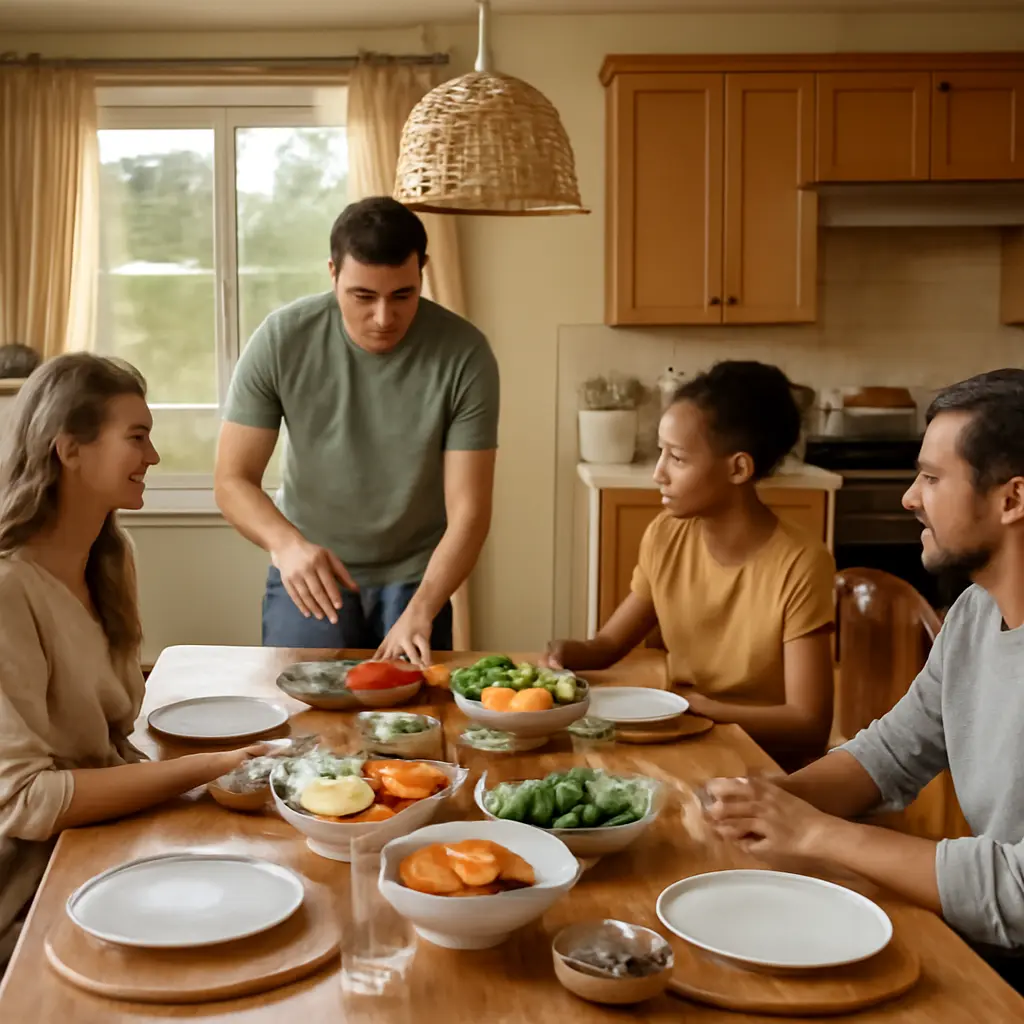
Shared meals take many forms: family dinners, celebrations, communal feasts, workplace lunches, and informal potlucks. Each can turn routine eating into a recognizable social event. A familiar table, a recurring dish, or a customary toast offers continuity, while the people and conversation make each gathering distinct.
Conversation makes a meal an experience
Conversation is the exchange of attention and stories that helps people interpret an occasion together. When guests recount a funny mishap, discuss a family update, or ask how a dish was made, they build a shared account of the gathering. That narrative gives a memory more context than the food alone: people may remember who sat beside them, what was said, and why everyone laughed.
The social setting can also shape how people experience a meal. The National Center on Addiction and Substance Abuse at Columbia University, in reports on family dinners, documented associations between regular family meals and positive outcomes for young people. Such associations do not establish that dinner itself produces those outcomes, but they underscore the meal’s potential as a dependable setting for conversation and connection.
Ritual gives ordinary gatherings continuity
A meal ritual is a repeated practice attached to eating, such as Sunday lunch, a birthday cake, a shared blessing, or letting each person describe the best part of their day. Rituals make occasions recognizable and give participants a role. Their value does not depend on elaborate planning; repetition can make a simple meal feel meaningful because people know they will meet again.
Family researchers have long examined routines and rituals as ways households create stability and shared identity. A recurring meal can act as a small but durable tradition: the menu may change, but the expectation of gathering remains. Over time, that repeated setting becomes a framework for remembering life events and family stories.
Food cues make personal memories vivid
Food-linked memory is the recollection of personal experiences prompted or shaped by a food’s taste, smell, texture, or preparation. It overlaps with autobiographical memory, which concerns events from a person’s own life. Researchers have found that sensory cues can bring back emotionally rich memories, and food is especially well placed to do so because eating engages several senses at once.
In a 2014 study published in the journal Memory, researchers C. H. Sutton and colleagues examined food-evoked autobiographical memories and found that food cues could prompt specific personal recollections. The researchers’ work helps explain why the smell of bread, a particular spice, or a familiar dessert may evoke a person or place more quickly than a general prompt. It does not mean every meal creates a lasting memory; emotion, repetition, personal relevance, and context all influence what people retain.
Taste and smell act as sensory reminders
A sensory reminder is a perceptual cue that brings an associated experience to mind. Taste and smell can be potent reminders because they are closely tied to eating contexts and emotional associations. A stew might recall a grandparent’s kitchen, while the scent of cinnamon may call back a winter holiday. The recollection is personal: the same flavor can mean comfort to one person and nothing special to another.
The scientific account is more nuanced than the popular claim that smell has a uniquely direct route to memory. Neuroscience research, including work discussed by Rachel Herz on smell and autobiographical memory, links odor cues with emotional and personal recollection, while emphasizing that learning and context matter. Food memories are therefore not simply stored in a flavor; they are connected to the circumstances in which people encountered it.
Cooking adds participation to the memory
Cooking together is a collaborative activity in which people plan, prepare, and share food. It can make a gathering memorable before anyone sits down: choosing ingredients, teaching a technique, or adapting a recipe gives participants something to do together. These actions also create details that may later serve as retrieval cues, such as a flour-covered counter or a relative’s instruction to taste the sauce.
The USDA’s Dietary Guidelines for Americans encourage shared meals as part of healthy eating patterns, while the U.S. Department of Agriculture’s nutrition education materials often frame food preparation as a practical skill. Beyond nutrition, preparing a dish with others can pass on knowledge and invite participation across generations. A recipe becomes more than a list of ingredients when people attach stories and personal methods to it.
Food traditions connect gatherings to culture and identity
A food tradition is a repeated food practice associated with a family, community, religion, region, or cultural identity. It may involve a particular dish, a seasonal ingredient, a way of serving, or a rule about who prepares and shares the food. UNESCO’s Convention for the Safeguarding of the Intangible Cultural Heritage recognizes food-related practices as part of living heritage when they are transmitted and renewed by communities.
Traditions help ordinary gatherings carry meaning beyond the immediate occasion. A dish can represent migration, adaptation, celebration, remembrance, or belonging. Traditions also change: families substitute ingredients, combine influences, and create new customs. Their continuity comes not from keeping every detail fixed but from people choosing to share and reinterpret them.
Family recipes preserve stories across generations
A family recipe is a food preparation method associated with a household or lineage, often passed along through demonstration as well as written instructions. Recipes can preserve practical knowledge—how long to knead dough or when a sauce is ready—alongside stories about the person who made the dish. Those stories make cooking a form of informal family history.
The Smithsonian Center for Folklife and Cultural Heritage documents foodways as expressions of knowledge, skill, and community life. This perspective helps explain why a recipe’s meaning cannot always be captured by measurements alone: memory, technique, and social context are part of the tradition. Recording a recipe with its origin and the people connected to it can help keep that context alive.
Celebrations turn meals into landmarks
A celebratory meal is food served as part of a milestone or shared observance, such as a birthday, wedding, religious holiday, graduation, or community festival. The meal marks time by linking a specific menu or practice to an occasion. Returning to the same dish each year can make the celebration easier to recognize and remember.
The scale of a celebration is not what makes it memorable. A simple cake, a shared breakfast before a major event, or a dish brought by a neighbor can become a lasting marker because it is connected to a meaningful moment. The food provides a sensory detail; the people and occasion supply its significance.
Small choices can make gatherings more memorable
A memorable gathering is not necessarily an expensive or elaborate one. It is an occasion where people feel included and have opportunities to connect. Hosts can encourage that atmosphere by choosing a format that suits their guests, making room for conversation, and treating food as a shared contribution rather than a performance.
For example, a neighborhood potluck invites participants to bring dishes and stories from their own lives. A regular family meal can offer an easy-to-repeat point of contact. A workplace lunch can help colleagues talk outside formal meetings. These examples are practical applications of the same idea: shared food provides a setting, while participation and attention create the social meaning.
Make participation welcoming and flexible
Inclusive hosting means accommodating guests’ dietary, cultural, physical, and financial needs without making them feel singled out. Ask about allergies and dietary restrictions in advance, label dishes where helpful, and offer options that do not depend on a single ingredient. A welcoming gathering also allows guests to contribute in ways other than cooking, such as setting the table, bringing a drink, or simply joining the conversation.
Flexibility matters because food practices differ across cultures and households. Avoid assuming that everyone eats the same foods or observes the same holidays. When guests are invited to explain a dish or tradition on their own terms, the meal can become an opportunity for respectful exchange rather than a test of familiarity.
Create a simple record of shared moments
A memory record is a brief note, photograph, recipe annotation, or audio story that preserves details of an occasion. Recording a dish’s name, who made it, and what was happening can strengthen its connection to the gathering. A shared digital album or a notebook kept near the kitchen can help families and friends revisit those details later.
Keep the record natural and respectful. Ask permission before photographing guests, and do not let documentation replace conversation. The aim is not to stage a perfect meal but to retain the small details that matter to the people present.
Conclusion: shared food turns time together into memory
Food can turn ordinary gatherings into lasting memories by combining social connection, conversation, sensory cues, and cultural meaning. Shared meals create opportunities for belonging; familiar tastes and smells can prompt personal recollections; and family recipes and celebrations connect present-day gatherings with wider histories. Research supports links between shared eating, social well-being, and food-evoked memories, while also reminding us that these relationships depend on individual and cultural context.
The practical lesson is simple: gather in ways that feel welcoming, invite people to participate, and make room for stories alongside the food. Try a recurring meal, cook a family recipe together, or ask guests to share the meaning behind a dish. Small acts of attention can give an ordinary meal a place in someone’s memory.
Sources: World Health Organization, Social Connection, https://www.who.int/health-topics/social-connection; Oxford Economics and National Centre for Social Research, The Social Market Foundation, The Social Market: A Report on the Social Value of Eating Together, 2017, https://socialmarketfoundation.org.uk/wp-content/uploads/2017/01/SMF-CASocial-Market-Report.pdf; World Happiness Report, Sharing Meals with Others: How Sharing Meals Supports Happiness and Social Connections, https://worldhappiness.report/ed/2025/sharing-meals-with-others-how-sharing-meals-supports-happiness-and-social-connections/; C. H. Sutton et al., Food-Evoked Autobiographical Memories, Memory, 2014, https://doi.org/10.1080/09658211.2013.877145; Rachel Herz, The Role of Odor-Evoked Memory in Psychological and Physiological Health, Brain Sciences, 2016, https://doi.org/10.3390/brainsci6030022; U.S. Department of Agriculture and U.S. Department of Health and Human Services, Dietary Guidelines for Americans, 2020–2025, https://www.dietaryguidelines.gov/; UNESCO, Convention for the Safeguarding of the Intangible Cultural Heritage, https://ich.unesco.org/en/convention; Smithsonian Center for Folklife and Cultural Heritage, Foodways, https://folklife.si.edu/collections/foodways